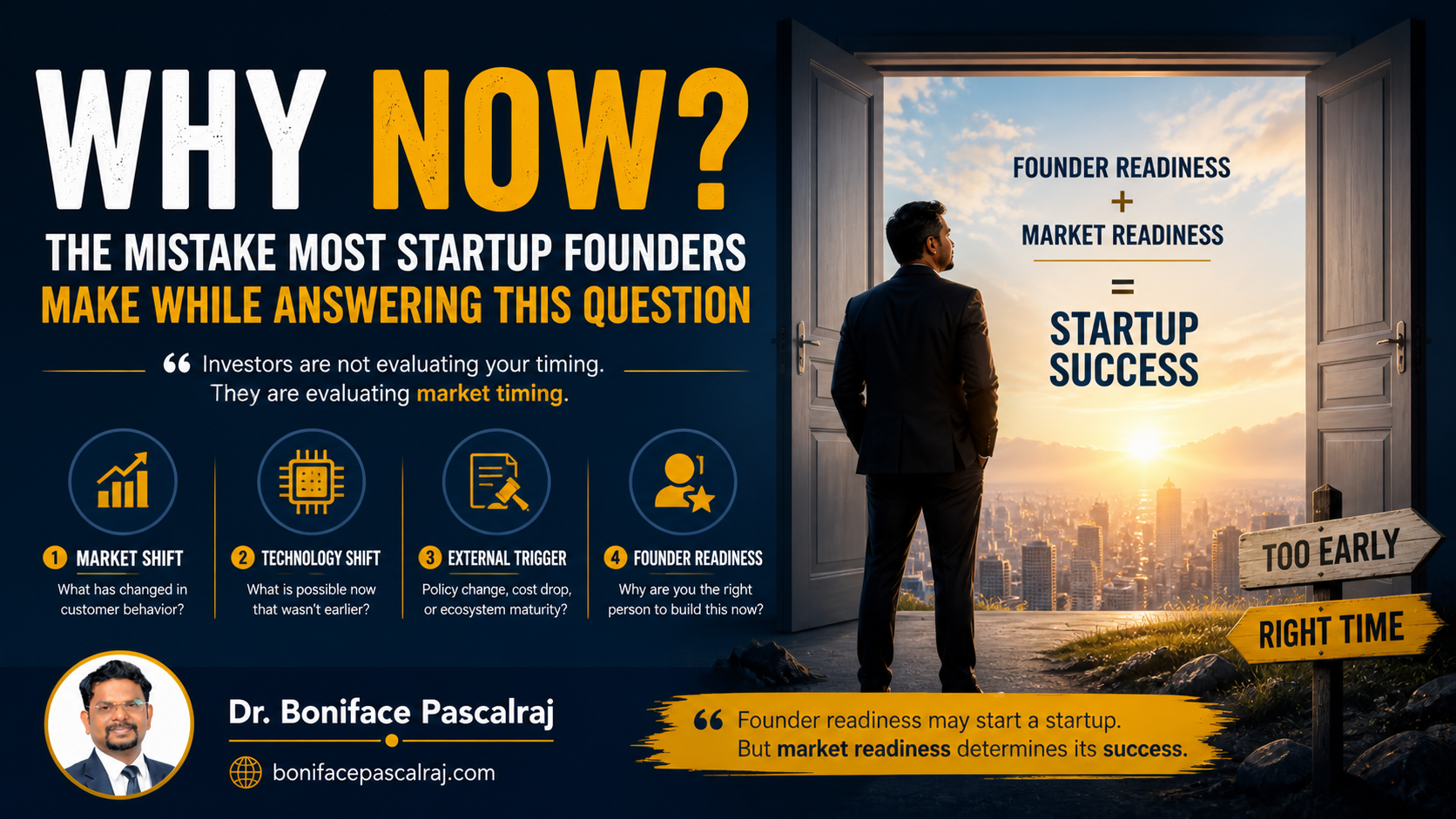
One of the most common questions founders face during pitches is simple:
“Why now?”
On the surface, it looks like a straightforward question. But in reality, it is one of the most misunderstood questions in the startup ecosystem.
Recently, while interacting with founders, I noticed a pattern in how this question is answered.
Most founders respond with something like:
- “I just completed my degree”
- “I now have time to focus”
- “I achieved a personal milestone”
While these answers are honest, they miss the point entirely.
The Core Insight: Investors Are Not Evaluating Your Timing
Here is the reality.
Investors are not evaluating your timing.
They are evaluating market timing.
What they are really asking is:
Why will this startup succeed now and not 5 years ago or 5 years later?
This distinction is subtle, but critical.
Founder Timing vs Market Timing: Understanding Both Sides
To be fair, founder timing is not irrelevant.
Founder Timing (Internal Readiness)
This includes:
- mental bandwidth
- conviction
- personal readiness
Without this, execution will fail.
However, this alone is not enough.
Market Timing (External Readiness)
This determines:
- adoption
- scalability
- investor interest
- speed of growth
Without market readiness, even the best ideas struggle.
The Real Answer Lies in Combining Both
The strongest startups emerge when two forces align:
Founder readiness meets market readiness
One without the other creates imbalance.
- Strong founder, weak market → slow traction
- Strong market, unprepared founder → poor execution
Where Founders Go Wrong
The mistake I often see is this:
Founders answer: “Why am I starting now?”
Instead of answering: “Why will this startup succeed now?”
This shift in perspective makes all the difference.
How Founders Should Think About “Why Now”
A strong answer to this question is not emotional. It is analytical.
It is built on identifying real-world shifts.
Three Critical Timing Triggers
- Market Shifts
What has changed in customer behavior? - Technology Inflection
What is possible today that was not possible earlier? - Policy or Ecosystem Changes
Have regulations, costs, or infrastructure improved?
These are signals that indicate timing advantage.
A Practical Framework for Founders
To simplify this, here is a framework founders can use:
The “Why Now” Framework
A strong answer must include:
1. Market Shift
What has changed in how customers behave or think?
2. Technology Shift
What new capabilities exist today?
3. External Trigger
Policy changes, cost reductions, or ecosystem maturity
4. Founder Readiness
Why are you the right person to build this now?
The Cost of Getting Timing Wrong
Many startups do not fail because the idea is bad.
They fail because they are early.
History is full of such examples:
- Online grocery existed long before it scaled successfully
- Video streaming existed before it became mainstream
- Electric vehicles existed before they became viable at scale
What changed over time?
Timing.
What Investors Are Really Listening For
When investors ask “Why now?”, they are looking for:
- evidence of a shift
- urgency in the opportunity
- proof of timing advantage
In simple terms:
Why will this work now?
Not:
Why do you want to do it now?
A Simple Reframe for Founders
The next time you are preparing for a pitch, ask yourself two questions:
- Why am I starting now?
- Why will the market accept this now?
This clarity will strengthen your narrative significantly.
Founder readiness may start a startup.
But market readiness determines its success.
The most successful founders are those who can clearly articulate not just their conviction, but the inevitability of their timing.