Recently, during a mentoring session with one of our incubated startups, I witnessed an interaction that stayed with me long after the session ended.
The startup founder had made significant progress since the previous mentoring session. The mentor acknowledged and appreciated the improvements. It was evident that the founder had taken the earlier feedback seriously and had worked diligently on the action items.
However, as the discussion progressed, the mentor suggested a fresh set of recommendations.
This time, the founder looked different.
He appeared perplexed.
You could almost see the gears turning in his mind as he tried to process the feedback. Some of the suggestions seemed to challenge his existing assumptions and understanding. While he respectfully acknowledged the feedback and agreed to work on it, it was clear that he needed time to absorb what had been shared.
After the session, I had a separate discussion with the mentor.
During our conversation, he made a statement that was simple, direct, and powerful:
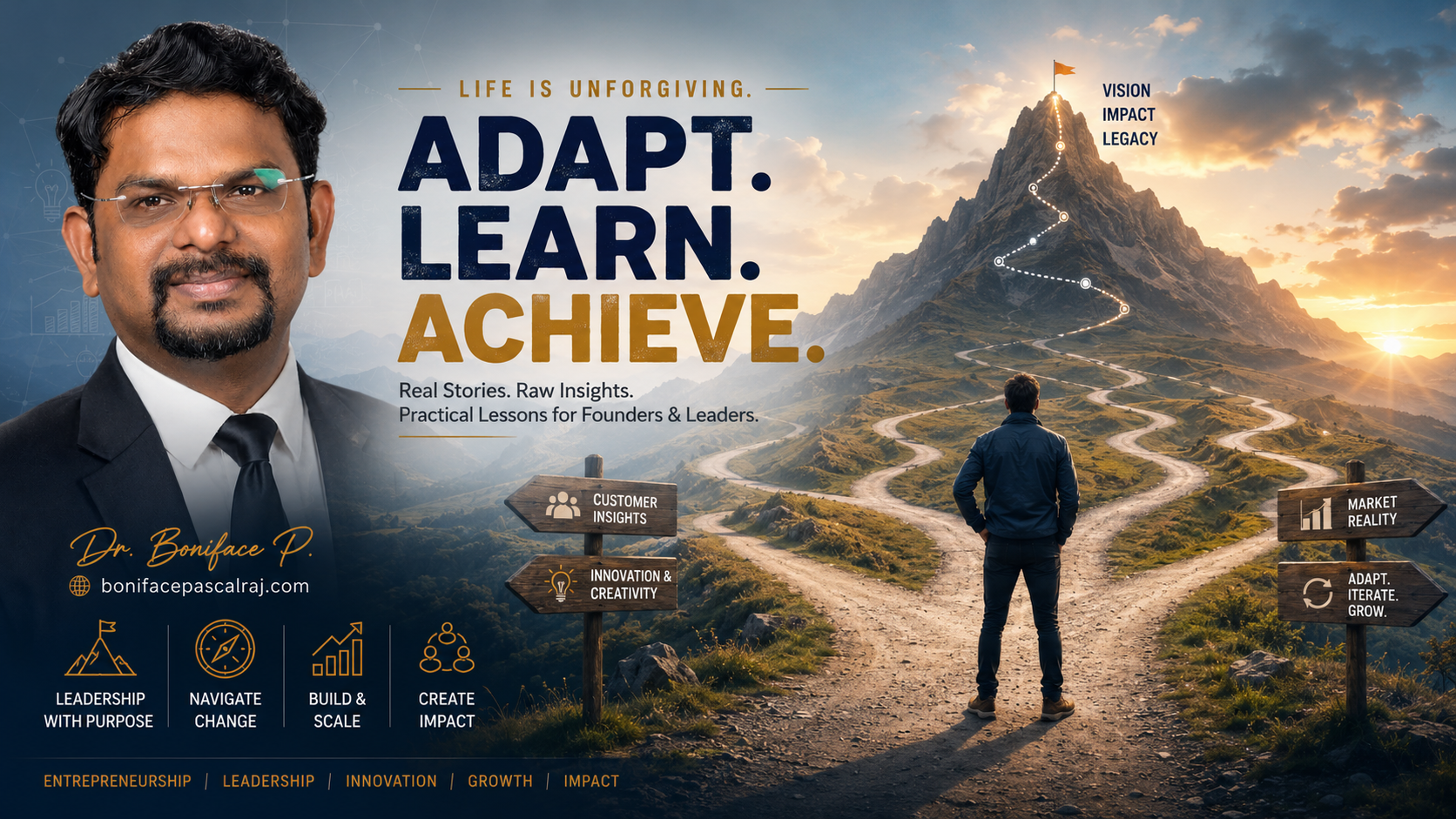
“Life is unforgiving.”
As someone who has spent more than a decade as an entrepreneur before moving into the startup ecosystem, I immediately understood what he meant.
The Market Does Not Reward Effort
Entrepreneurship is one of the few journeys where effort and outcomes are not always directly proportional.
Founders often spend months or years building products.
They sacrifice time.
They sacrifice money.
They sacrifice stability.
They work late nights and weekends.
Yet, despite all this effort, the market may still reject the product.
Why?
Because the market does not reward effort.
The market rewards value.
Customers rarely care how difficult it was to build a product. They care about whether the product solves their problem.
This is a difficult truth for many founders to accept, especially those coming from strong technical backgrounds.
The Technology Trap
One challenge I frequently observe among startup founders is what I call the “technology trap.”
Many founders become fascinated by what they can build.
Few spend enough time understanding what customers actually need.
The result?
A technically brilliant solution looking for a problem.
This is particularly common among engineering founders.
They enjoy product development.
They enjoy solving technical challenges.
They enjoy building new features.
But customers do not buy technology.
Customers buy outcomes.
They buy convenience.
They buy efficiency.
They buy solutions to their problems.
One of the mentor’s key points during the session was precisely this.
Founders cannot build something simply because they know how to build it.
They must understand whether the market needs it.
And if the market needs it, they must understand how the market wants it delivered.
The Uncomfortable Side of Entrepreneurship
This is where entrepreneurship becomes uncomfortable.
Most founders would rather spend time improving the product than talking to customers.
Customer discovery can be repetitive.
Sales conversations can be exhausting.
Market feedback can be brutal.
At times, customers may reject months of work in a matter of minutes.
But these uncomfortable conversations are often where the most valuable insights emerge.
Many startup failures are not caused by poor technology.
They are caused by poor market understanding.
The founder builds what they believe customers need rather than validating what customers actually need.
This is also why I often remind founders that building a startup is not always about exciting breakthroughs. Much of entrepreneurial success comes from consistently doing the mundane activities that move the business forward. I explored this idea in my earlier article, Mastering the Mundane: The Unseen Side of Building a Startup.
Progress Is Better Than Perfection
At the same time, founders must avoid another common trap.
Waiting for the perfect product.
Waiting for the perfect market conditions.
Waiting for complete certainty.
Perfection is rarely achievable.
Markets evolve.
Customer preferences change.
Competitors emerge.
The only way to truly learn is to engage with the market.
Reid Hoffman, the co-founder of LinkedIn, famously said:
“If you’re not embarrassed by the first version of your product, you’ve launched too late.”
The quote captures an important entrepreneurial truth.
Customers are often the best source of product feedback. Waiting endlessly to perfect a product in isolation can result in founders solving problems that customers never had in the first place.
This is a theme I have reflected on before in Chasing Excellence, Not Perfection: A Business Leader’s Perspective. Excellence should be pursued relentlessly, but perfection should not become an excuse for inaction.
This is why I often remind founders:
Progress is better than perfection.
Launch.
Learn.
Adapt.
Improve.
Repeat.
The market itself becomes the greatest mentor.
Adapt Without Abandoning the Vision
One of the most fascinating aspects of successful startups is that very few reach success through their original plan.
Airbnb adapted.
Flipkart adapted.
Netflix adapted.
Almost every successful startup has evolved significantly from its initial assumptions.
The vision may remain the same.
The path rarely does.
That, perhaps, is the essence of entrepreneurial resilience.
Not stubbornly sticking to a plan.
But remaining committed to the destination while being flexible about the route.
Or, as I wrote in another article, simply “keeping the ball rolling.” Momentum matters. Founders do not always need perfect answers; they need continuous forward movement. Small course corrections made consistently often outperform grand plans that never leave the drawing board.
Final Thoughts
The mentor’s statement continues to resonate with me:
“Life is unforgiving.”
But I would add a small extension to it.
Life is unforgiving to founders who refuse to learn.
Yet it can be remarkably rewarding to founders who listen, adapt, and keep moving forward.
Entrepreneurship is not about building what we want to build.
It is about creating what the market needs.
And sometimes, the hardest feedback we receive today becomes the reason we succeed tomorrow.