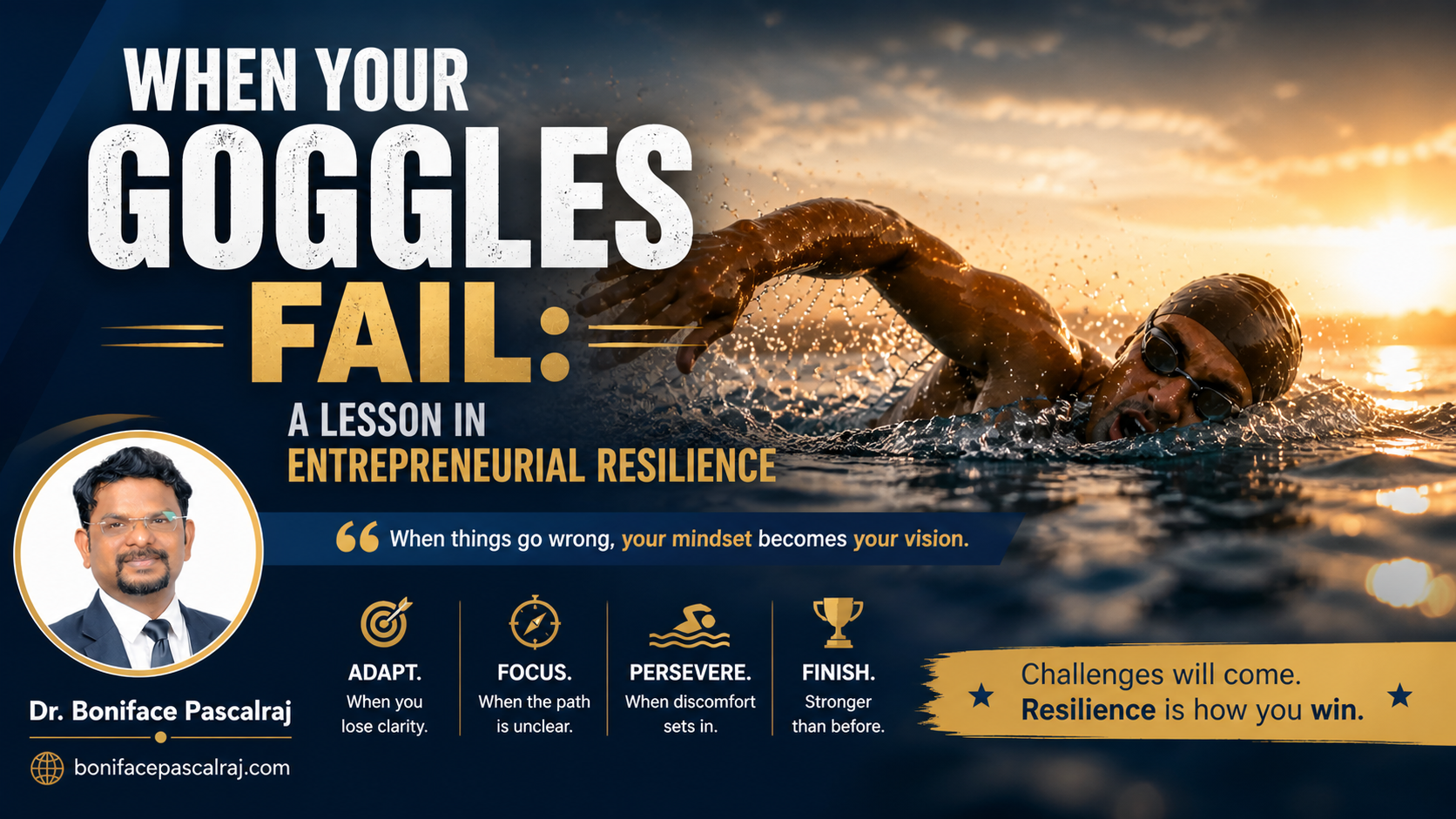
At a recent session at Loyola College on Entrepreneurial Resilience, I made the session interactive, as usual.
As the session progressed, I asked a simple question:
“Tell me a moment where you showed resilience.”
One student stood up.
His name was Prasanna.
He was a swimmer.
The Goggles Moment
During an important competition, something went wrong.
His goggles shifted mid-race.
His vision blurred.
Discomfort set in.
In a race where precision and timing matter, this could have ended everything.
But Prasanna did not stop.
He remembered something his coach had taught him:
Count your strokes to estimate distance.
So he adjusted.
He swam without clarity.
But not without direction.
And he finished among the winners.
Why This Story Matters for Founders
That story stayed with me.
Because this is exactly how entrepreneurship works.
At some point in your journey, your “goggles” will fail.
- Your product may not work as expected
- Investors may say no
- The market may not respond
- Your plans may collapse midway
The question is not whether disruption will happen.
The question is:
How will you respond when it does?
Resilience in the Real World
This pattern is not limited to one student or one moment.
We see it across domains.
In Sports
At the 2009 WTA Championships, Caroline Wozniacki suffered severe full-body cramps during a match.
She collapsed.
She was in visible pain.
She took medical timeouts.
Yet she continued.
And she won.
In Entrepreneurship
Some of the most successful founders have faced their own “goggles moments.”
Kiran Mazumdar-Shaw – Building Against the Odds
At a time when biotechnology was almost unheard of in India, she faced repeated rejections from banks and investors. There was no ecosystem and very little belief.
She did not wait for ideal conditions.
She started small, built credibility step by step, and stayed the course.
Today, Biocon stands as a global biotech company.
Airbnb – Surviving Before Scaling
Before becoming a global platform, the founders struggled to raise funds and were close to shutting down.
Instead of giving up, they designed and sold cereal boxes during the U.S. elections to survive.
It was not scalable.
It was not glamorous.
But it kept the company alive.
Flipkart – Adapting to Reality
In the early days of Indian e-commerce, customers did not trust online payments.
Instead of blaming the market, Flipkart adapted.
They introduced Cash on Delivery.
That single decision aligned with customer behavior and unlocked trust at scale.
The Common Thread
Different stories.
Same principle.
They did not wait for ideal conditions.
They did not complain about constraints.
They adapted, improvised, and moved forward.
What Resilience Really Means
Resilience is not about avoiding problems.
It is about:
- Staying calm under pressure
- Falling back on fundamentals
- Adapting without losing direction
- Continuing despite discomfort
One insight I shared with the students:
Resilience is not built during the crisis.
It is revealed during the crisis.
Because when things go wrong, you do not rise to the occasion.
You fall back to your training.
Startups do not fail because of challenges.
They fail when founders stop.
So the next time something goes wrong, ask yourself:
Are you reacting… or responding?
Because when your “goggles” fail,
your mindset becomes your vision.