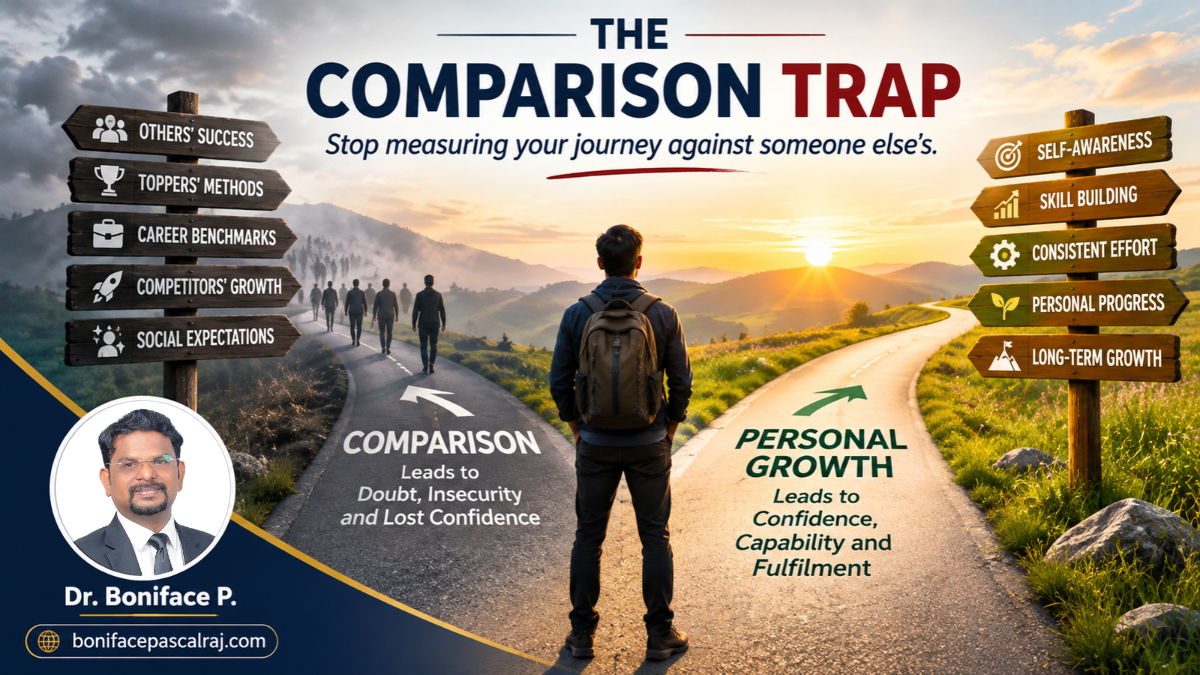
From fair skin to academic toppers, career success to startup growth, the benchmarks we compare ourselves against often have little to do with our true potential.
There are many ways in which people quietly lose confidence.
Sometimes it happens when someone criticises us.
Sometimes when we fail.
And sometimes, strangely enough, when we see someone else succeeding.
A newspaper article I read recently made me reflect on this.
What caught my attention was not merely the health concern. It was the larger social issue behind it.
The article, published in The Hindu on November 22, 2026, discussed the continuing obsession with fairness creams and the concerns surrounding certain skin-lightening products, including the potential presence of harmful substances such as heavy metals.
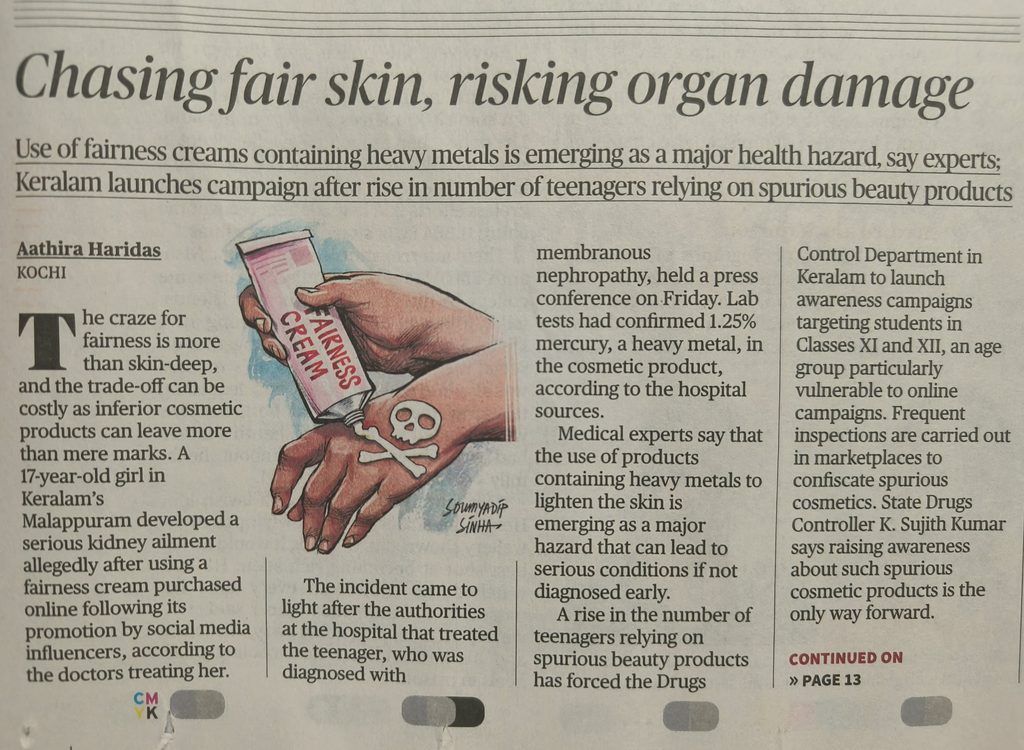
Despite years of awareness, campaigns promoting acceptance of different skin tones, and even cosmetic brands moving away from the terminology of fairness, the preference for fair skin continues to influence perceptions.
I have seen this mindset around me.
Pre-teen girls who feel inferior because they are not fair-skinned.
Working professionals who believe fair skin could improve their career prospects.
Married women who believe their spouses prefer them to have lighter skin.
It is deeply concerning when something as natural as our skin colour becomes a reason to question our worth, appearance or confidence.
But the more I reflected on this, the more I realised that this is not merely a problem associated with skin colour.
It is a manifestation of a much larger problem: comparison.
And comparison has a way of quietly influencing our confidence in almost every aspect of life.
The Benchmark We Never Chose
Society constantly creates benchmarks for us.
Fair skin is considered desirable.
Academic toppers are held up as examples of success.
Certain colleges are considered superior.
Some careers are perceived to be more prestigious than others.
Some entrepreneurs are celebrated because they raised millions.
Some professionals are admired because they reached leadership positions at a younger age.
The problem is not that we admire people or learn from their achievements.
The problem begins when we start measuring our own worth against these benchmarks.
We begin questioning ourselves.
Am I good enough?
Am I doing enough?
Am I progressing fast enough?
Am I following the right path?
And sometimes, we begin doubting ourselves even when we are doing perfectly well.
That is the comparison trap.
When I Was Preparing for My Board Examinations
I remember experiencing something similar during my school days.
As we approached our board examinations, the media would often feature interviews with students who had topped the previous year’s examinations.
They would speak about their preparation.
The number of hours they studied.
Their routines.
Their sacrifices.
Their preparation strategies.
Their discipline.
Their approach to revision.
I was preparing thoroughly for my examinations as well.
But when I listened to these interviews, something subtle happened.
I began comparing my preparation with theirs.
I was not necessarily less prepared.
I had studied.
I understood the subjects.
I was reasonably confident about my preparation.
Yet, because I had not followed the same preparation methods as the toppers, a small doubt began creeping into my mind.
Am I doing enough?
Should I have prepared differently?
Have I missed something?
The irony was that the comparison was not necessarily based on my actual preparedness or understanding.
It was based on someone else’s approach.
And that doubt affected me.
Looking back, I realise that I allowed someone else’s preparation strategy to become the benchmark against which I evaluated my own.
I was comparing methods instead of evaluating outcomes.
That distinction matters.
Two people may have entirely different approaches to preparation, learning and problem-solving.
One may spend eight hours studying.
Another may spend five hours studying effectively.
One may make extensive notes.
Another may learn through repeated practice.
There is no universal method that works identically for everyone.
The real question should not be whether we are doing things exactly like someone else.
It should be whether our approach is helping us achieve our intended outcome.
The MBA Experience: A Different Starting Point
I encountered a similar feeling when I joined my MBA programme.
During the first trimester, Finance was introduced.
Coming from an engineering background, I did not have the same academic foundation as students who had studied commerce.
Even though the faculty conducted an orientation using the Class XI Accountancy textbook to help students familiarise themselves with the fundamentals, I still had that underlying feeling of being at a disadvantage.
I was conscious of my background.
I wondered whether students from commerce would find the subject easier.
Would they understand concepts faster?
Would I have to work harder to catch up?
Would my lack of prior exposure affect my performance?
The reality was that I was entering a new discipline and learning something unfamiliar.
That should have been a perfectly normal experience.
Yet, when we compare ourselves with people who have different starting points, we tend to interpret the difference in background as a difference in capability.
It is not always so.
Someone else’s head start does not mean we are incapable of catching up.
Someone else’s familiarity does not mean we cannot master the subject.
Someone else’s journey does not invalidate ours.
We often mistake a difference in starting points for a difference in potential.
That is one of the most damaging consequences of comparison.
Comparison Can Steal Confidence Without Taking Away Capability
What makes comparison particularly dangerous is that it does not necessarily diminish our actual ability.
It diminishes our belief in that ability.
We may still possess the knowledge.
We may still have the skills.
We may still be capable of performing.
But our confidence begins to weaken because we are constantly looking at someone else.
This happens everywhere.
A young professional compares their salary with that of a friend.
An entrepreneur compares their startup with a company that has raised significant funding.
A founder compares their product with a competitor that has a larger team, better technology and stronger distribution.
A student compares their academic performance with that of a topper.
A leader compares their career trajectory with that of someone who seems to be progressing faster.
We rarely account for the differences in circumstances, opportunities, experiences, starting points, constraints or choices.
We see the visible outcome.
We do not see the entire journey behind it.
And then we use that incomplete picture to evaluate ourselves.
That is hardly a fair comparison.
The Startup Ecosystem Is Not Immune to This
I see this particularly often in the startup ecosystem.
Founders are constantly exposed to stories of startups raising large funding rounds, entering new markets, achieving impressive valuations, winning awards and scaling rapidly.
These stories can be inspiring.
But they can also become unhealthy benchmarks.
A founder who is building steadily may suddenly feel inadequate because another startup has raised ₹10 crore.
A team working on customer validation may feel they are falling behind because another company has already launched.
A founder who is building a sustainable business may begin questioning their strategy because someone else is pursuing aggressive expansion.
The danger is that founders begin making decisions based on comparison rather than conviction.
They may:
- Pursue growth before establishing product-market fit.
- Raise funds unnecessarily because others are fundraising.
- Enter markets they do not fully understand.
- Hire prematurely.
- Change their business model without sufficient evidence.
- Chase visibility instead of building customer value.
This is where comparison can become expensive.
A startup’s journey is shaped by its market, customer segment, business model, capital requirements, team, technology and timing.
There is no universal timeline for success.
Some startups require years of research and development.
Some can scale quickly through digital distribution.
Some businesses are capital-intensive.
Others grow through customer revenue.
Comparing their progress without understanding these differences can lead founders away from the very strategy that makes their venture viable.
Be Obsessed With the Customer, Not the Competitor
This reminds me of one of the strategic principles associated with Jeff Bezos and Amazon: customer obsession.
The idea is simple but powerful.
Instead of constantly focusing on what competitors are doing, focus relentlessly on understanding the customer.
What does the customer need?
What frustrates them?
What are they struggling with?
What can we do better?
What is still not being solved?
When a company becomes deeply obsessed with its customer, it develops a better understanding of the market and is more likely to make decisions that create meaningful value.
The same principle can be applied to our personal lives.
Instead of constantly asking:
How is someone else progressing?
Perhaps we should ask:
How am I progressing?
Instead of:
Why is someone else doing better than me?
Ask:
What can I learn, and what can I improve?
Instead of obsessing over another person’s achievements, focus on understanding yourself.
Your strengths.
Your weaknesses.
Your opportunities.
Your limitations.
Your priorities.
Your next step.
In business, customer obsession helps companies create value rather than merely imitate competitors. In life, self-awareness helps us grow rather than merely imitate others.
Comparison Is Not Always Bad
I do not believe comparison is inherently harmful.
Benchmarking can be valuable.
Learning from successful people is important.
Observing how others solve problems can help us improve.
Healthy competition can push us to perform better.
The difference lies in what we do with the comparison.
Does it inspire us to learn?
Or does it make us question our worth?
Does it help us identify an improvement?
Or does it make us feel inferior?
Does it provide direction?
Or does it create unnecessary anxiety?
Comparison is useful when it becomes a source of learning.
It becomes destructive when it becomes a measure of self-worth.
We should be able to admire someone else’s success without feeling that our own journey is somehow diminished.
We should be able to learn from someone else’s methods without believing that we must replicate them.
We should be able to celebrate someone else’s progress without interpreting it as evidence of our own failure.
The Only Competition That Truly Matters
Over the years, I have increasingly come to believe that our real competition is ourselves.
Not in the sense that we should ignore the world around us.
Not in the sense that we should stop learning from others.
But in the sense that our most meaningful measure of progress should be how much we have improved from where we were.
Are we wiser than we were yesterday?
Have we improved our skills?
Have we become better at managing our emotions?
Are we making better decisions?
Are we more disciplined?
Are we more aware of our weaknesses?
Are we closer to the goals that genuinely matter to us?
These are far more meaningful questions than whether we are ahead of someone else.
Someone else’s success is not your failure.
Someone else’s progress is not your stagnation.
Someone else’s opportunity is not your missed opportunity.
Life is not a race in which everyone starts at the same point, follows the same route and reaches the finish line at the same time.
Our journeys are different.
Our circumstances are different.
Our priorities are different.
And our definitions of success need not be identical.
Progress Is a Better Measure Than Comparison
If we must measure ourselves, let us measure our progress.
The student who struggled with a subject but improved significantly has made progress.
The entrepreneur who went from an idea to their first paying customer has made progress.
The professional who learned a new skill and became more capable has made progress.
The leader who learned to listen better, communicate more clearly and manage a team with greater empathy has made progress.
Progress does not always look impressive to others.
Sometimes it is invisible.
Sometimes it is slow.
Sometimes it involves correcting mistakes rather than achieving milestones.
Sometimes it is simply learning not to repeat yesterday’s mistake.
But progress is progress.
And when we consistently focus on our own improvement, confidence begins to emerge from competence rather than comparison.
That is a far more sustainable foundation.
The newspaper article about fairness creams was a reminder of how deeply external standards can influence our perception of ourselves.
But the issue extends far beyond skin colour.
It exists in our classrooms.
Our workplaces.
Our careers.
Our relationships.
Our entrepreneurial journeys.
We are constantly exposed to benchmarks that tell us what success should look like, how quickly we should achieve it, and what we should aspire to become.
It is easy to get caught up in those expectations.
But perhaps the most important thing we can do is pause and ask ourselves whether the benchmark we are chasing is truly ours.
Learn from others.
Admire others.
Celebrate others.
But do not allow someone else’s journey to make you question your own worth.
You do not have to follow someone else’s preparation method to succeed in an examination.
You do not have to come from a commerce background to understand finance.
You do not have to raise millions to build a meaningful startup.
You do not have to achieve everything by a certain age to lead a fulfilling life.
You simply have to understand where you are, recognise where you want to go, and keep working towards becoming better.
Comparison may tell you where someone else stands. Progress tells you who you are becoming.
And perhaps that is the only comparison worth making.
Your competition is not the person standing next to you. It is the person you were yesterday.