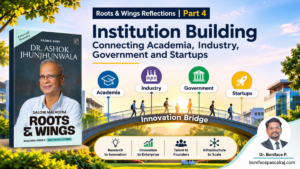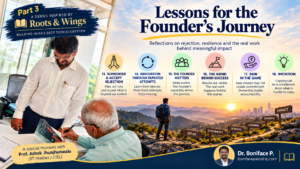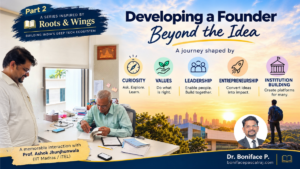
This is the final instalment of a personal reflection series inspired by Roots & Wings: Building India’s Deep Tech Ecosystem, the authorised biography of Prof. Ashok Jhunjhunwala. I have brought together the final two instalments because their themes connect naturally. The first explores how innovation ecosystems are built through patience, relationships and a pursuit of excellence. The second turns the focus towards the founder: staying grounded, distinguishing attention from value, and building a sustainable entrepreneurial journey.
Building Innovation Ecosystems
24. Forest, Butterfly and the Incubator as a Garden
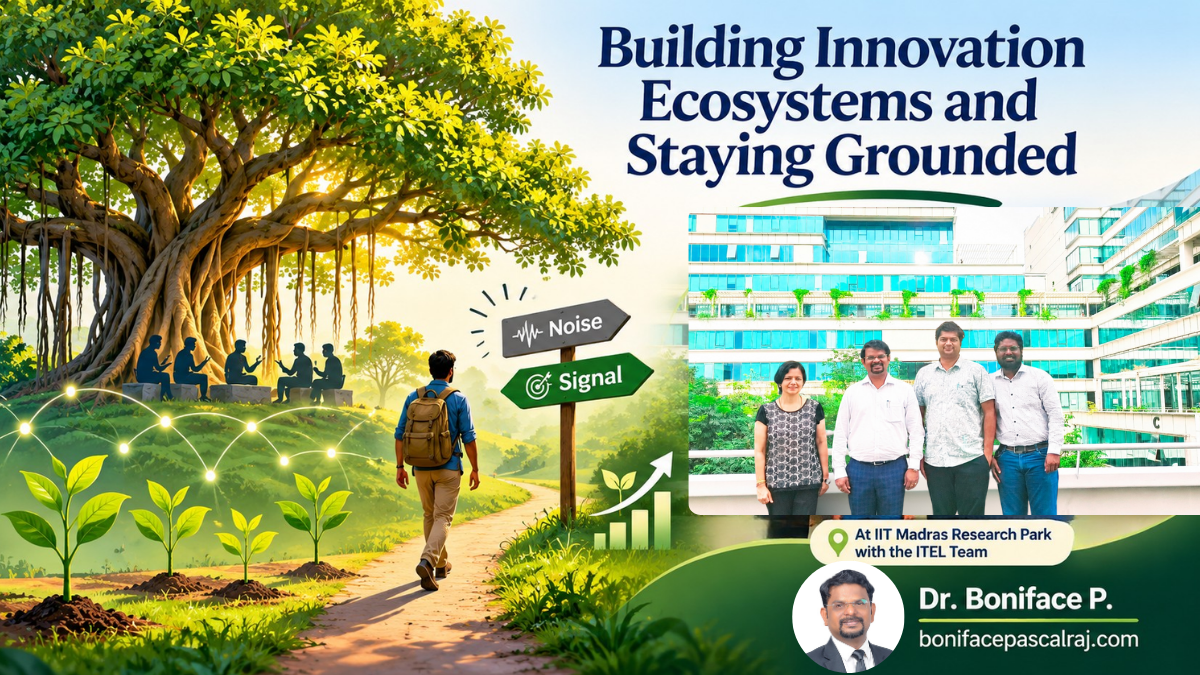
What Prof. Ashok’s experience made me notice Prof. Ashok’s forest metaphor for IIT Madras Research Park is one of the images I enjoyed most in the book. Startups are like saplings. Deep-tech ventures can be like bamboo, taking years to show visible growth and then accelerating. An incubator can be like a banyan tree, extending support through roots that reach beyond the original trunk. And a forest needs more than sunlight: decay, friction and renewal are also part of its life.
What resonated with me I have my own metaphor for incubation. I see an incubator as a garden, the incubation team as gardeners and the startup journey as something like the metamorphosis of a butterfly. The role of the gardener is not to manufacture the butterfly. It is to create the conditions in which transformation can happen.
What it means for founders and the ecosystem That distinction matters. An incubator cannot guarantee that every startup will succeed. It can improve the environment by providing mentoring, technical access, networks, funding pathways, infrastructure and opportunities to learn. Some startups will grow quickly. Some will take years. Some will not survive. A healthy ecosystem must have enough diversity and patience to accommodate all three.
25. Network / Looping In
What Prof. Ashok’s experience made me notice Prof. Ashok’s use of his network to solve challenges and connect the right person with the right founder is a reminder that a network is useful only when it becomes active. A long contact list is not necessarily a strong network. Its real strength lies in trust, relationships and the willingness to connect people when an opportunity arises.
What resonated with me My MBA experience at Loyola gave me a phrase I have carried for years: “Our network is our net worth.” What I appreciate about that idea more today is that relationships often reveal their value much later. Some people I knew during those years became relevant to my work 10 or 12 years later. Networking, therefore, should not be treated as a transaction. Staying connected, sharing knowledge and helping without expecting an immediate return can create value over time.
What it means for founders and the ecosystem For founders, networking is not simply about collecting contacts or attending events. It is about building relationships that can translate into conversations, introductions, collaborations and business opportunities. For an ecosystem, the ability to connect a founder with the right mentor, customer, investor, technology partner or another founder can unlock possibilities. A strong ecosystem is not defined only by the number of startups or institutions it has. It is also defined by the strength of the network of people willing to help one another.
A personal moment I was amused by a small personal detail in the book. It mentions Prof. Ashok’s habit of taking a picture of a person when saving their phone number. When he saved my number, he did the same with me and took a photograph. It was a small moment at the time. After reading that passage, I remembered it with a smile. It made the book feel a little more personal and brought back a moment from our interaction.
26. Success? No. Excellence? Yes.
What Prof. Ashok’s experience made me notice Prof. Ashok refers to Rancho from 3 Idiots to illustrate an important distinction: the pursuit of excellence should take precedence over the pursuit of success. The emphasis is on focusing on the quality of what we do rather than being preoccupied with the outcomes we hope to achieve.
What resonated with me This idea took me back to my MBA days at Loyola Institute of Business Administration, whose tagline is “In pursuit of excellence with ethics.” That phrase has stayed with me over the years. I have also come to appreciate the difference between excellence and perfection. Excellence is about doing the work well and continuously improving. Perfection, on the other hand, can sometimes become a reason to delay action. Success is an outcome influenced by several factors, many of which may be beyond our control.
What it means for founders and the ecosystem For founders, this distinction can be liberating. We cannot control every market response, funding decision or competitive move. We can, however, control the quality of our preparation, our learning, our integrity and the effort we put into improving what we build. Incubators and ecosystem enablers can apply the same principle by continuously improving the quality of their support, mentoring, networks and interventions. Pursuing excellence gives us something constructive to work on every day, even when outcomes remain uncertain. Excellence vs Perfection
Staying Grounded While Building
27. Noise vs Signal
What Prof. Ashok’s experience made me notice
Prof. Ashok’s caution about media attention, unnecessary highlights and the distractions that can come with recognition made me look back at my own early entrepreneurial experience. Attention can feel like progress because it is visible. But visibility and value are not the same thing.
What resonated with me
When I was building my earlier venture, I received media attention partly because I had skipped campus placements and chosen entrepreneurship. I was invited to speak and participate as a resource person in different forums. At the time, it felt encouraging. But I eventually started asking myself a more uncomfortable question: what is this actually giving me? Is it helping me scale the startup? Is it bringing customers, partnerships, talent or capital?
What it means for founders and the ecosystem
That question changed how I looked at recognition. Media coverage can be useful when it creates a meaningful business or ecosystem outcome. Testimonials can build credibility when they help someone make a decision. Awards, speaking opportunities and visibility can open doors, but none should become a substitute for traction. Ecosystems, too, should look beyond activity and visibility and ask whether their efforts are helping startups acquire customers, build partnerships, attract talent, access capital or make meaningful progress. The better question is not how much attention an activity generated, but what that attention enabled. Media Coverage
28. Frugality vs Personal Growth
What Prof. Ashok’s experience made me notice
The book’s discussion of people who give themselves completely to a cause, sometimes at the cost of their own financial wellbeing, made me think about how our understanding of entrepreneurship is changing. There was once a tendency to romanticise sacrifice as proof of commitment.
What resonated with me
I have become more conscious of the fact that a founder is also a person with responsibilities, financial needs and a life outside the company. The ecosystem is gradually recognising this. Investors and supporters can provide capital for the business, but the founder also needs enough personal stability to continue making good decisions over a long period.
What it means for founders and the ecosystem
Frugality is not the same as deprivation. Being disciplined about spending is different from making the founder financially unsustainable. A startup may need to conserve cash, but the person building it also needs the ability to live, learn and remain functional. Financial stress can affect judgement and the ability to stay the course. Investors, incubators and ecosystem supporters should recognise that founders have responsibilities beyond the venture. Frugality should preserve resources for growth, not turn personal sacrifice into a measure of commitment.
What I Am Taking Away
Building something meaningful is not only about having a good idea or achieving individual success. It is also about creating the conditions in which people and ideas can grow, nurturing relationships, pursuing excellence and remaining grounded along the way. An innovation ecosystem needs the patience of a forest, the care of a garden, the strength of networks and a culture of excellence. At the same time, founders must learn to distinguish visibility from value and frugality from self-neglect. They are building businesses, but they are also building lives. The journey has to be sustainable for both. Building an innovation ecosystem is not merely about helping startups grow. It is about creating an environment where people, ideas, institutions and relationships can grow together.
About the book
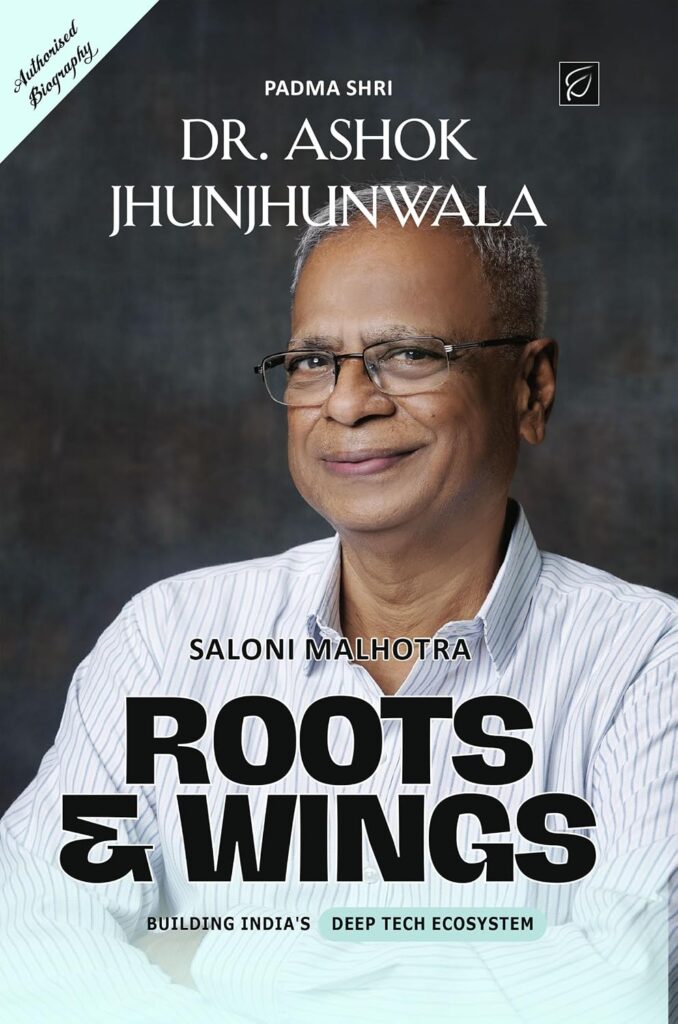
Roots & Wings: Building India’s Deep Tech Ecosystem is the authorised biography of Prof. Ashok Jhunjhunwala. I approached the book less as a conventional biography and more as a source of questions about leadership, innovation, entrepreneurship, and institution building.
This series is therefore not intended to be a book review. It is a personal reflection on the ideas that stayed with me and the way they connect with my own entrepreneurial and incubation experiences.
If you would like to explore the book itself, you can find it on Amazon.