


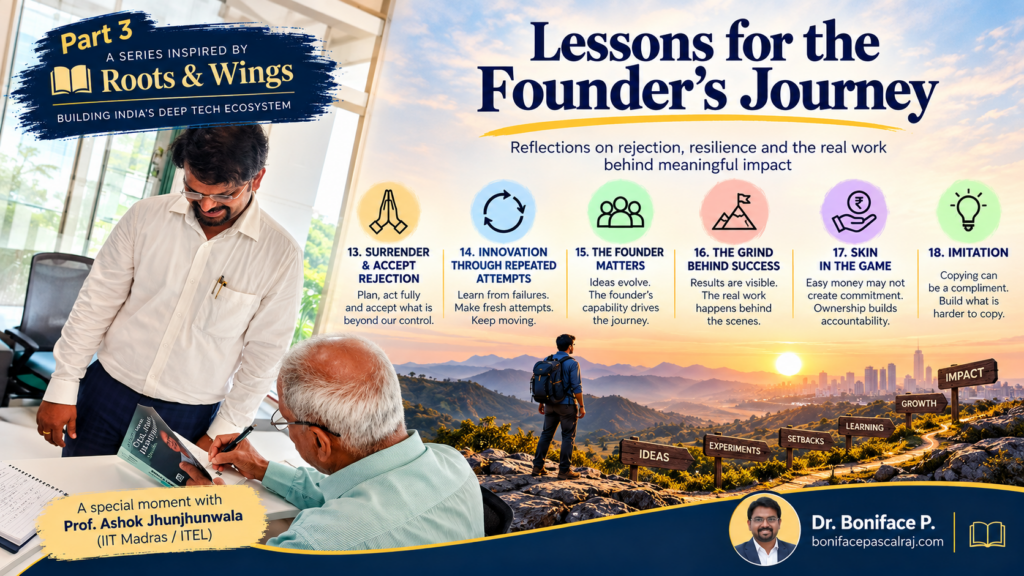

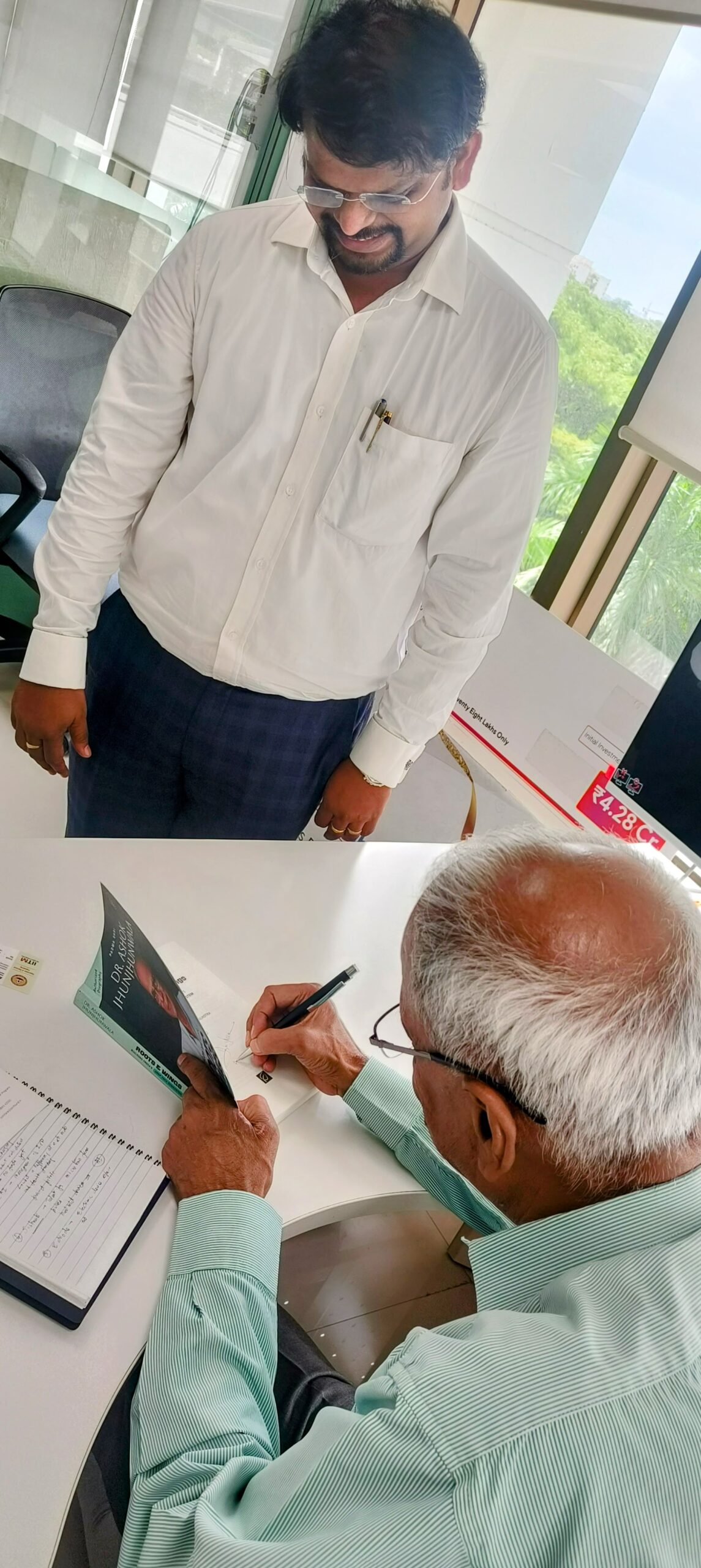
This is Part 3 of a six-part personal reflection series inspired by Roots & Wings: Building India’s Deep Tech Ecosystem, the authorised biography of Prof. Ashok Jhunjhunwala by Sal. These are reflections on the ideas that resonated with me and the connections I see with my own journey.
13. Surrender to a Higher Will and Accepting Rejection
What Prof. Ashok’s experience made me notice Prof. Ashok’s reflections on surrendering to a higher will and accepting rejection made me think about the difficult balance between planning and letting go. One can make a plan, work hard, and still encounter an outcome that was not in the plan.
What resonated with me I have asked myself this question many times: should we wait for God’s plan, or should we make our plan and remain willing to bend according to God’s ways as we progress? There have been moments when I prayed, waited for a sign and then accepted the natural consequences of the path I had chosen. I do not see surrender as doing nothing. I see it as acting with intention while accepting that some outcomes are outside my control.
What it means for founders and the ecosystem Prof. Ashok’s own experience of being rejected or overlooked for the IIT Madras Director position, despite being eligible, makes this particularly human. For a founder, rejection can feel even more public because every pitch, customer conversation and funding decision can seem like a judgement on the person. But one rejection does not have to define the journey. Make the plan, act fully, accept what cannot be controlled and continue where influence remains.
14. Innovation Through Repeated Attempts
What Prof. Ashok’s experience made me notice Prof. Ashok’s observation that repeated failures through fresh attempts can be the pathway to successful innovation is one of the strongest startup lessons in the book.
What resonated with me It reminded me of Morgan Housel’s idea in The Psychology of Money that extreme outcomes often come from long tails. A small number of events can create a large share of the outcome. In entrepreneurship, that means many attempts may fail or remain ordinary while one eventually creates disproportionate value. Thomas J. Watson Sr.’s often-cited idea of increasing the rate of failure captures the same spirit: take more thoughtful risks, learn faster, and keep moving.
What it means for founders and the ecosystem But there is an important distinction. Repeating the same mistake is not innovation. A fresh attempt should carry forward what the previous attempt taught us. The goal is not to fail for the sake of failing. It is to increase the number of informed experiments.
15. Startup Selection: The Founder Matters
What Prof. Ashok’s experience made me notice Prof. Ashok’s approach to startup selection emphasises the founder’s involvement, capability, and wherewithal. The idea is that the person building the company can matter more than the initial idea because ideas evolve while the founder has to navigate everything that comes next.
What resonated with me This is also a thesis I have repeatedly encountered while working around incubators and angel networks. In early-stage ventures, the original business model may change several times. What often remains critical is the founder’s ability to learn, attract people, handle adversity, and execute.
What it means for founders and the ecosystem I have written about this through the lens of founders versus ideas in early-stage fundraising. The question is not whether the idea matters. It does. The deeper question is whether the founder has the capacity to discover and execute what the idea needs to become a viable company. My reflection on founders versus ideas in early-stage fundraising
16. Success and the Grind Behind It
What Prof. Ashok’s experience made me notice The book’s reminder about the grind behind every success is easy to understand and surprisingly easy to forget. People see the visible result and often want the same result without seeing the years of work that produced it.
What resonated with me I have often noticed this in the way people look at successful actors, public figures, or entrepreneurs. We see the fan base, the recognition, and the outcome. We do not see every rejection, practice session, financial compromise, failed attempt, and ordinary day that came before it. The same is true of startups.
What it means for founders and the ecosystem This is one reason I keep returning to the less glamorous side of entrepreneurship. Building a company involves repeated follow-ups, customer conversations, documentation, problem-solving, cash-flow decisions, and countless tasks that will never become a LinkedIn post. The question I increasingly ask myself is simple: am I willing to do what it actually takes to build something of my own? Mastering the Mundane: The Unseen Side of Building a Startup
17. Soft Loan: The Value of Having Skin in the Game
What Prof. Ashok’s experience made me notice Prof. Ashok’s experience of choosing a soft loan rather than simply accepting easy money for building the research park made me think about ownership and accountability. His broader point is that easy money can sometimes reduce the seriousness with which a venture is approached.
What resonated with me This reminded me of a line from Rajinikanth’s Padayappa: ‘கஷ்டப்படாமல் எதுவுமே கிடைக்காது. கஷ்டப்படாமல் கிடைக்கிறது என்னிக்குமே நிலைக்காது.’ In English, the idea is that what comes without effort may not endure. That line has stayed with me because it captures something founders often learn the hard way.
What it means for founders and the ecosystem I would add an important nuance. Grants and other forms of support are extremely valuable, especially for risky early-stage innovation where private capital may not yet be available. The issue is not whether money is free or borrowed. The issue is whether the founder has enough ownership, accountability and commitment to use the money well. Skin in the game can take financial, reputational, or personal forms.
18. Imitation
What Prof. Ashok’s experience made me notice The story of a company visiting Prof. Ashok, understanding an idea, and then launching something similar is an uncomfortable but real part of innovation. Copying can bruise the ego, but it can also be evidence that an idea has struck a chord.
What resonated with me I experienced a much smaller version of this during my entrepreneurial days. Around 12–15 years ago, when I was building Ulaginoli, I had invested considerable effort in creating a website with a strong brand and sophisticated layout. A reseller visited us and later copied the website almost exactly. My first reaction was obvious: should I see this as a compliment or as a reason to worry about copycats?
What it means for founders and the ecosystem The more useful question today is what exactly is difficult to copy. A website, feature, or visible product can often be replicated. Customer relationships, execution capability, proprietary knowledge, culture, data, speed of learning, and trust are much harder to copy. Imitation, therefore, forces a founder to think beyond what is visible and build deeper defensibility.
About the Book

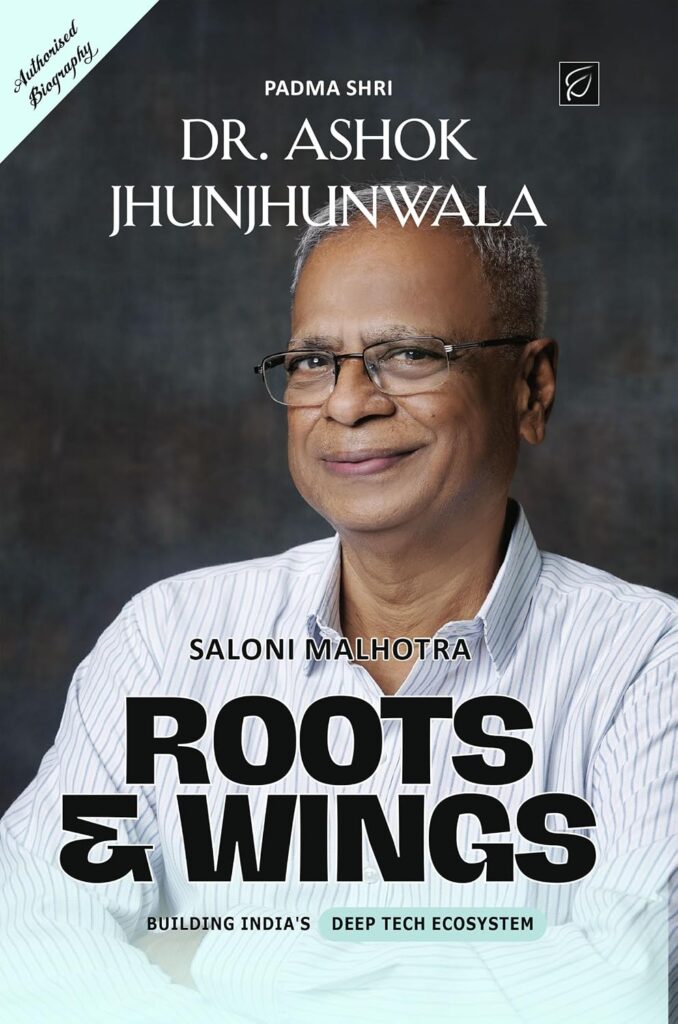
Roots & Wings: Building India’s Deep Tech Ecosystem is the authorised biography of Prof. Ashok Jhunjhunwala. I approached the book less as a conventional biography and more as a source of questions about leadership, innovation, entrepreneurship, and institution building.
This series is therefore not intended to be a book review. It is a personal reflection on the ideas that stayed with me and the way they connect with my own entrepreneurial and incubation experiences.
If you would like to explore the book itself, you can find it on Amazon.