


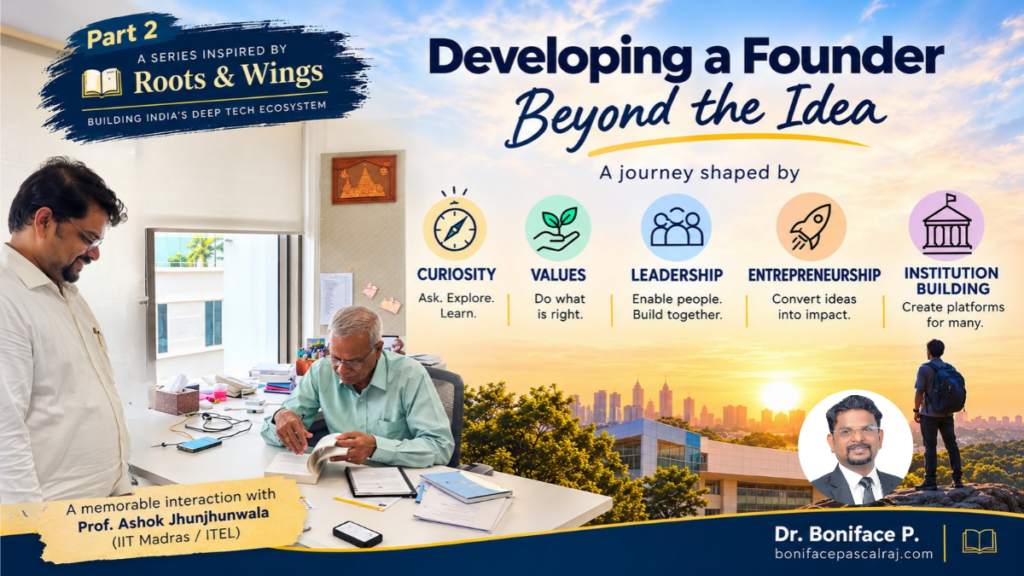
This is Part 2 of a six-part personal reflection series inspired by Roots & Wings: Building India’s Deep Tech Ecosystem, the authorised biography of Prof. Ashok Jhunjhunwala by Saloni Malhotra. These are reflections on the ideas that resonated with me and the connections I see with my own journey.

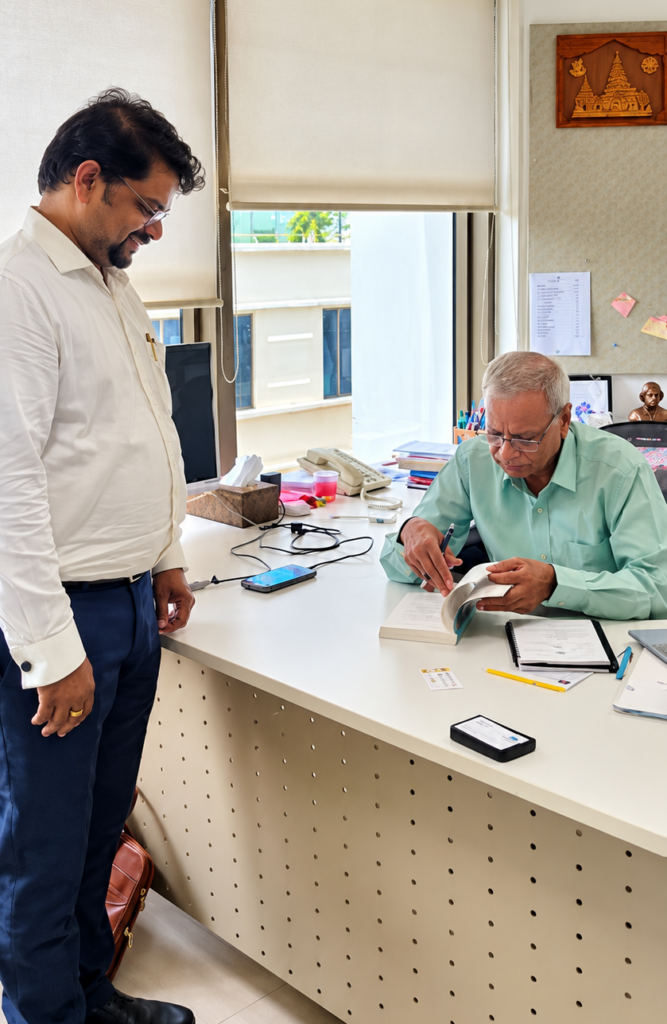
7. Tough Love
What Prof. Ashok’s experience made me notice Prof. Ashok’s approach to leadership includes pushing people beyond their comfort zones. Leaders, in this view, are not simply people who make others comfortable. They groom the next level of leaders, bring out capability and sometimes insist on execution when people would rather remain where they are.
What resonated with me I have experienced this from both sides. There are moments when a leader’s push can feel uncomfortable, especially when you are already stretched. But with hindsight, some of the growth we value most comes from someone refusing to let us settle. Prof. Ashok’s criticism of a culture that could stop at publishing research, and his insistence on taking innovations further, made me think about how leadership often requires difficult conversations.
What it means for founders and the ecosystem Startup founders need the same kind of push. Mentoring cannot become permanent reassurance. A mentor sometimes has to ask the uncomfortable question, challenge the assumption, or point out that the founder is hiding behind activity instead of creating progress. Leadership has to balance empathy with expectations. The tightrope that leaders have to walk.
8. Value-Driven Leadership
What Prof. Ashok’s experience made me notice The book made me think about the difference between being successful and creating value. Prof. Ashok’s influence has come not only through technology and research but also through institution building and the people who have grown through the institutions he helped create.
What resonated with me This immediately reminded me of a line attributed to Albert Einstein: ‘Try not to become a man of success, but rather try to become a man of value.’ I first came across that idea through my engineering professor, Dr. Siva Subramanian, and it has stayed with me.
What it means for founders and the ecosystem For me, value-driven leadership means asking what remains because we were here. It may be a person we helped develop, a system we improved, a founder we connected to the right opportunity, a student who found confidence or an institution that became stronger. In incubation, the temptation is to count only visible outputs. But leadership is also about the value that compounds through people.
9. Limitations Held Us Back
What Prof. Ashok’s experience made me notice Prof. Ashok reflects that sometimes our own thoughts become the hurdle and that our limitations can hold us back. I found that observation surprisingly practical because the biggest constraint is not always external.
What resonated with me I have used a very simple personal tactic learnt from Brian tracy that when a negative or demotivating thought becomes repetitive, physically interrupt the pattern, even by hitting my palm lightly, and consciously redirect the thought. I do not present this as a scientific technique. For me, it became a simple reminder that I do not have to believe every discouraging thought that appears in my mind automatically.
What it means for founders and the ecosystem Founders constantly hear internal versions of ‘this will not work’, ‘someone else is better’, ‘the market is too difficult’ or ‘it is too late’. Some of those thoughts may contain useful signals. But if they become unquestioned conclusions, they become limitations. The founder has to distinguish evidence from fear.
10. Building Something of Our Own
What Prof. Ashok’s experience made me notice One of the stories in the book about the desire to build something of one’s own made me reflect on identity and legacy. The idea of creating an identity beyond a family name is powerful because it asks a simple question: What will I build that is genuinely mine?
What resonated with me During my engineering days, a classmate, Amarnath, once gave me a thought that stayed with me. In our naming convention, the father’s initial often comes first. He suggested writing the father’s initials after the name to ensure that we work until our father could proudly say, ‘I am her/his father.’ That completely changed the way I thought about identity.
What it means for founders and the ecosystem We may begin our journey carrying our parents’ names, institutions’ names, or the names of people who gave us opportunities. But eventually, our work has to create its own credibility. Building something of our own is not necessarily about fame. It is about earning the right to be associated with something meaningful.
11. The Intrapreneurial Spirit
What Prof. Ashok’s experience made me notice The book’s account of initiatives such as N-Logue, OOPSisee, Tele Health, Chennai Kavigal and Vortex Gramteller made me think about the power of intrapreneurship. Innovation does not always begin with leaving an organisation. It can begin with taking responsibility for an idea within one.
What resonated with me My own MBA years at Loyola Institute of Business Administration played an important role here. I initiated and led the Entrepreneurship Cell and was involved in starting Radius, a social service initiative. I also worked with my batchmates to initiate Operations specialisation at LIBA. Those experiences gave me confidence to build and lead something. By the time placements came, I had already started thinking seriously about creating my own venture rather than simply looking for a job.
What it means for founders and the ecosystemThis is why organisations should create spaces where people can initiate, experiment and learn. Intrapreneurship gives people the experience of ownership before they necessarily become founders. It also gives institutions a way to convert employee curiosity into new capabilities. My first startup journey
12. Curiosity Keeps Us Moving
What Prof. Ashok’s experience made me notice Prof. Ashok’s curiosity is another quality that stood out to me. The repeated instinct to ask what is next, what is missing and how something can be solved is a powerful way of staying relevant.
What resonated with me I have always believed that one of the most useful habits for an entrepreneur is the willingness to ask why. Curiosity prevents us from accepting the first explanation. It makes us look deeper into customer behaviour, technology, business models and our own assumptions.
What it means for founders and the ecosystem That is why I have written separately about the power of asking ‘why’. For a founder, curiosity is not merely a personality trait. It becomes a competitive capability because the market keeps changing and yesterday’s answer may not solve tomorrow’s problem. The power of asking why
What I Am Taking Away
For me, becoming a founder is not only about starting a company. It is about becoming the person capable of carrying the responsibility of building one. Tough love, values, managing internal limitations, creating an identity, experimenting within organisations, and staying curious are all parts of that development.
About the Book

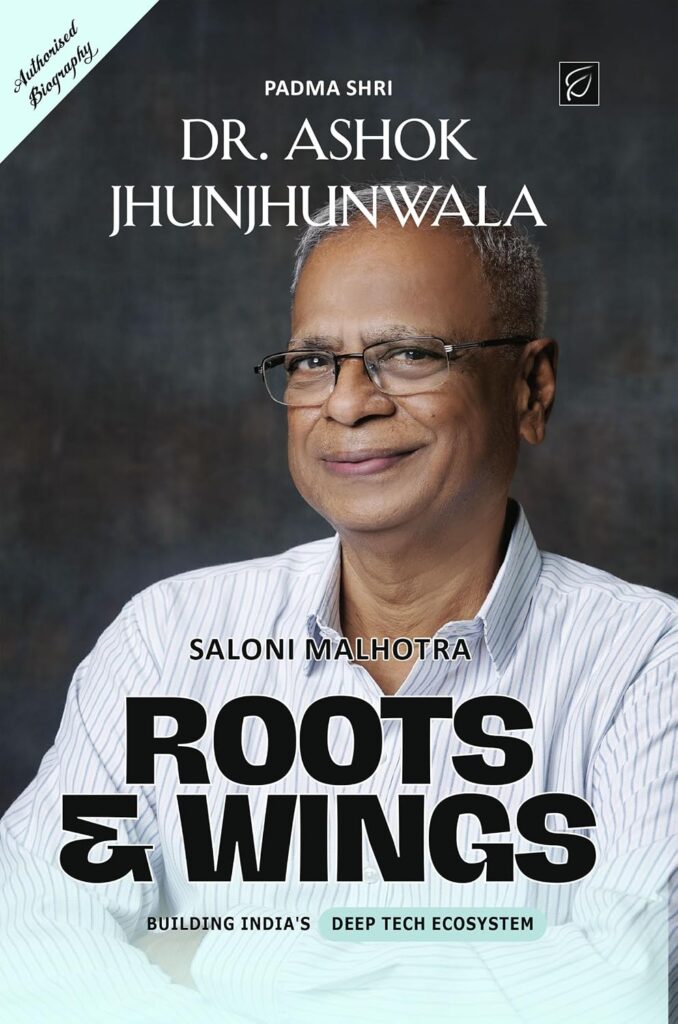
Roots & Wings: Building India’s Deep Tech Ecosystem is the authorised biography of Prof. Ashok Jhunjhunwala. I approached the book less as a conventional biography and more as a source of questions about leadership, innovation, entrepreneurship, and institution building.
This series is therefore not intended to be a book review. It is a personal reflection on the ideas that stayed with me and the way they connect with my own entrepreneurial and incubation experiences.
If you would like to explore the book itself, you can find it on Amazon.