


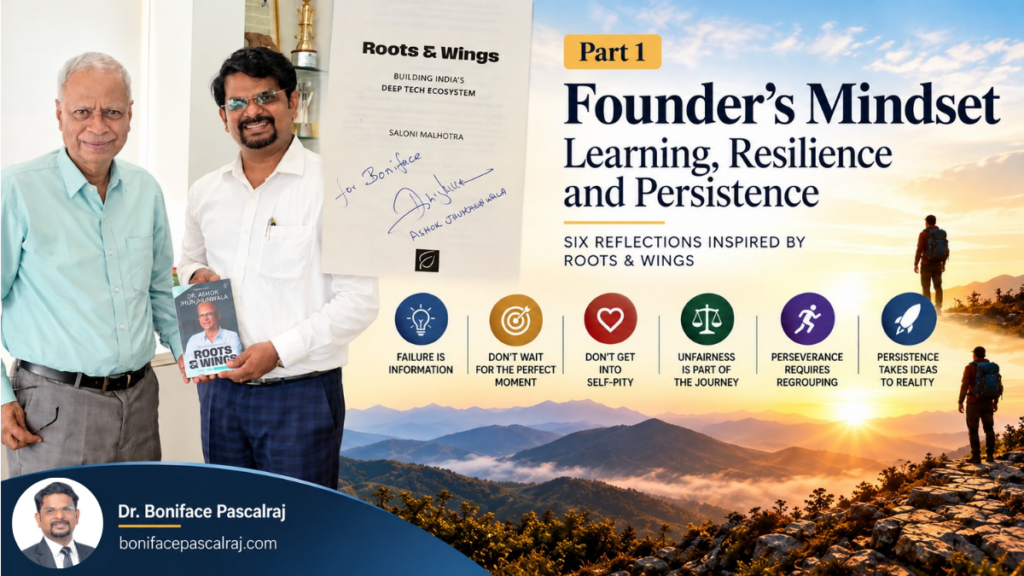
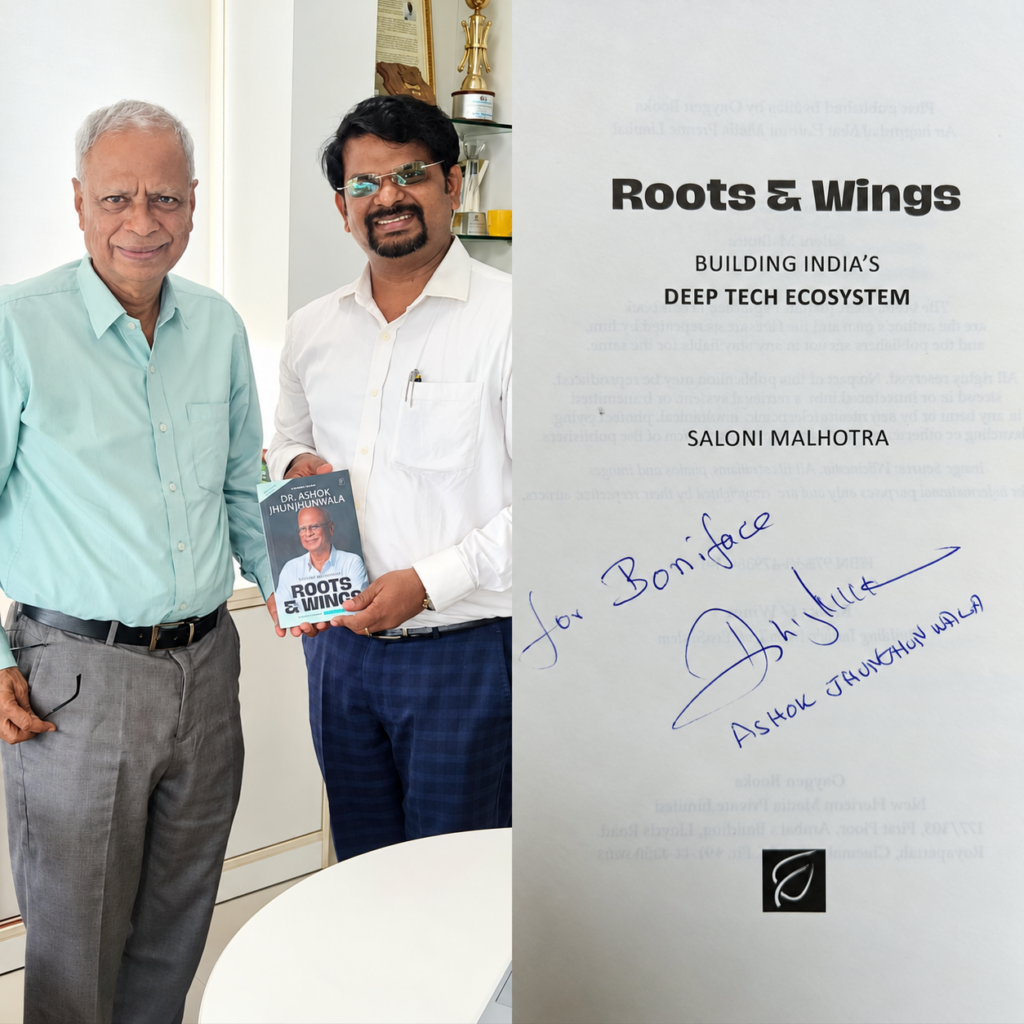
I recently had the opportunity to meet Prof. Ashok Jhunjhunwala and get my copy of Roots & Wings, his authorised biogrpahy by Saloni Malhotra, signed by him. That made reading the book a little different for me. I was not simply reading about a distinguished technologist and institution builder; I was reading the reflections of someone I had the privilege of meeting, and thinking about what those experiences mean for people building ventures and innovation ecosystems today.
The reflections in this series are my own. They are not an attempt to interpret Prof. Ashok’s life in its entirety, nor to suggest that my experiences are comparable to his. They are simply the ideas from the book that made me pause, look at my own journey, and think about the work I do with founders and the wider innovation ecosystem.

1. Failure Is Information
What Prof. Ashok’s experience made me notice Prof. Ashok’s approach to failure is one of the ideas that immediately stayed with me. Failure is not something to hide or simply move past. It is something to study, analyse and understand for the message it carries. That mindset also creates room for innovation because experimentation without the possibility of failure is hardly experimentation at all.
What resonated with me Startup building has repeatedly reinforced this for me. A startup is essentially a continuous cycle of experimentation and validation. We test a proposition, speak to customers, build something, observe the response and then decide what to change. Not every result will be the result we wanted. The important question is what we learn from it. In my own entrepreneurial journey, I have come to see failure less as a verdict and more as information. The real waste is not a failed experiment; it is failing to learn from one.
What it means for founders and the ecosystem What I see in incubation work is the same principle at another level. Founders need an environment where they can test assumptions without being made to feel that every unsuccessful experiment is a personal failure. At the same time, creating room for failure cannot mean creating room for repeating the same mistake without learning. The value is in reflection, adaptation and the next experiment. My earlier reflections on understanding why businesses succeed or fail.
2. Don’t Wait for the Perfect Moment
What Prof. Ashok’s experience made me notice The book also made me think about how easily action can get delayed when we wait for the right moment. There is always another thing to improve, another uncertainty to resolve and another reason to postpone a decision.
What resonated with me I have experienced this myself. Whether it is building a business, starting a new initiative or taking a career decision, waiting for the perfect moment can quietly become a way of avoiding movement. Over time I have become more convinced that perfection is rarely a useful starting condition. We can begin with what we know, learn from what happens and improve along the way. That is very different from being careless. It is about accepting that progress often has to happen before certainty.
What it means for founders and the ecosystem That is why I have written earlier about chasing excellence rather than perfection. The distinction matters particularly in startups, where speed of learning is often more valuable than the illusion of being fully ready. Chasing excellence rather than perfection.
3. Don’t Get Into Self-Pity
What Prof. Ashok’s experience made me notice The book reminded me that the Prof. Ashok and his team did not romanticise struggle or remain trapped in it. They acknowledged difficulties and then moved forward.
What resonated with me This touched something personal for me. There was a phase in my own life when I could slip into a victim mindset and ask why something had happened to me. Over time I realised that self-pity may explain how I feel, but it does not change what I need to do next. I had to learn to pull my socks up, accept the situation and move forward.
What it means for founders and the ecosystem Entrepreneurs encounter enough rejection, uncertainty and comparison without adding an internal narrative that makes every setback bigger than it is. Resilience is not pretending that difficulties do not hurt. It is refusing to let the difficulty become your identity. My reflection on moving from victim to survivor.
4. Unfairness
What Prof. Ashok’s experience made me notice One of the more striking ideas in the book is the acceptance that unfairness is part of the world. The lesson is not to celebrate unfairness, but to recognise that life and institutions do not always operate according to our preferred sense of justice. The line that stayed with me was the analogy that being a vegetarian does not mean you can expect a lion not to eat you.
What resonated with me I have struggled with the same question in different forms: Why me? Why did this happen when I had done what I thought was right? Over time, I have tried to shift from asking why something is unfair to asking what is actually within my control. That does not make the unfairness disappear. It changes where I put my energy.
What it means for founders and the ecosystem In entrepreneurship, this distinction is important. A founder may face a competitor with more capital, a customer who changes direction, a regulation that arrives at the wrong time, or a rejection that feels undeserved. The useful response is not denial. It is to identify what can still be influenced and act there. Sometimes, only much later, we realise that an apparently unfair event also redirected us towards something better.
5. Perseverance
What Prof. Ashok’s experience made me notice Prof. Ashok and his teams repeatedly regrouped when progress stalled, problems surfaced or the solution was not immediately clear. The important word for me is regrouped. Perseverance is not blindly pushing in exactly the same direction; it is continuing the journey while being willing to rethink the route.
What resonated with me Building a startup or beginning a new journey can be tiring and confusing. There are perfectly logical reasons to give up. Cash pressure, customer silence, technical problems, family responsibilities and simple exhaustion can all make stopping seem rational. I have experienced that emotional roller coaster myself. Yet one belief has stayed with me: a startup fails when the founder stops.
What it means for founders and the ecosystemPerseverance also connects with something I have written about before: the seemingly mundane work of building a company. Much of entrepreneurship is not dramatic. It is the repeated follow-up, testing, fixing, selling, learning and trying again. Enthusiasm has to coexist with discipline. Success and failure both need to be treated with some equanimity because neither is permanent. The entrepreneurial roller coaster and the mundane work behind a startup.
6. Persistence
What Prof. Ashok’s experience made me notice The book’s account of Prof. Ashok’s persistence in securing land for what became IIT Madras Research Park particularly struck me. The process crossed administrative and political changes. A sanction associated with one government did not automatically guarantee continuation under the next. Yet the effort continued until the outcome was achieved.
What resonated with me This reminded me that persistence is different from enthusiasm. Enthusiasm can start an initiative. Persistence carries it through delays, changes in circumstances and periods when there is no visible progress. In my own work, I have seen how ideas can remain only ideas until somebody keeps pushing them through the practical stages of execution.
What it means for founders and the ecosystemThat is why I increasingly think of execution as the bridge between a good idea and a meaningful outcome. In an innovation ecosystem, there are many people who can generate ideas. The scarce capability is often the willingness to stay with an idea long enough to make it real, while adapting when reality demands it. Moving execution from ideas to reality.
What I Am Taking Away
The six ideas in this part come together for me as a founder’s operating mindset: treat failure as information, start before everything is perfect, do not get trapped in self-pity, accept that some things will be unfair, persevere through uncertainty and persist through the long periods when progress is not visible. None of these ideas promises an easy journey. They make the journey more navigable.
About the Book


Roots & Wings: Building India’s Deep Tech Ecosystem is the authorised biography of Prof. Ashok Jhunjhunwala. I approached the book less as a conventional biography and more as a source of questions about leadership, innovation, entrepreneurship and institution building.
This series is therefore not intended to be a book review. It is a personal reflection on the ideas that stayed with me and the way they connect with my own entrepreneurial and incubation experiences.
If you would like to explore the book itself, you can find it on Amazon.